The Strategist by Bartholomew Sparrow
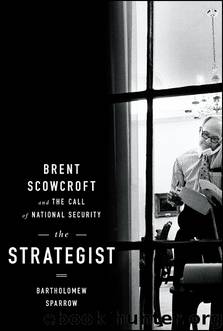
Author:Bartholomew Sparrow [Sparrow, Bartholomew]
Language: eng
Format: epub
ISBN: 9781586489632
Publisher: PublicAffairs
22
ONE GERMANY
IN EARLY 1989, it would have been hard to find a single prominent journalist or political leader who favored the creation of a single, united Germany. “Neither West nor East has an interest in German reunification,” the International Herald Tribune foreign affairs columnist William Pfaff wrote in February 1989. “This is a fact of international life.” And indeed, French president François Mitterrand, British prime minister Margaret Thatcher, Soviet president Mikhail Gorbachev, and other European heads of state, East and West alike, were all uncomfortable with the idea of a reunited Germany in view of that country’s unhappy twentieth-century history and its potentially vast political and economic clout.
Policy makers close to Brent Scowcroft were also deeply skeptical of a reunified Germany. Former president Nixon wrote Bush soon after the Berlin Wall came down, “I would strongly urge that you indicate that you are not going to negotiate German unification or the future of NATO with Gorbachev. The recent loose talk about the ‘inevitability’ of German unification,” Nixon commented, “is irresponsible.”445 Henry Kissinger, too, opposed reunification and called for “the peoples of Eastern Europe to choose their own political future.”446
But German chancellor Helmut Kohl made it happen. He envisioned a reunited Germany, staked his political future on that vision, and persevered. He had one indispensable ally: the president of the United States. Unlike Kohl’s fellow European heads of state, Bush fully supported Kohl’s efforts. “I’d love to see Germany reunited,” Bush said in the Washington Times on May 16, 1989. A single Germany was “fine,” he said, as long as it could be achieved “on a proper basis.” At a press conference in Helena, Montana, four months later, the president announced that German reunification was for the two Germanys to decide. “I believe that Germany has earned the right to be accepted as a full democratic partner,” Bush declared on September 18.447 And on October 25, in a front-page story in the New York Times based on an interview with Bush, R. W. Apple Jr. reiterated that the president didn’t fear German reunification, warning only that it would take “prudent evolution” and a lot of work for the two German governments. Chancellor Kohl and others in the German government took heart from the self-confidence and ease with which President Bush stated his acceptance of German reunification within NATO.448
The president was ahead of everyone in his administration—including Baker and Scowcroft. So when Gates called the national security advisor from Helena, telling him of Bush’s statement, Scowcroft exclaimed, “Oh shit.”449 The national security advisor recognized the thorny issues reunification would raise, from short-range nuclear weapons and conventional force levels in Europe to the future of the NATO and Warsaw Pact alliances.
Scowcroft wanted to proceed deliberately. He understood that the fate of German reunification would depend on how the Soviet Union, with its thousands of tanks and hundreds of thousands of soldiers on the ground, reacted. And neither Scowcroft nor anyone else in the administration could be sure of Gorbachev’s hold on power or of how far his reforms could go.
Download
This site does not store any files on its server. We only index and link to content provided by other sites. Please contact the content providers to delete copyright contents if any and email us, we'll remove relevant links or contents immediately.
| Anthropology | Archaeology |
| Philosophy | Politics & Government |
| Social Sciences | Sociology |
| Women's Studies |
The Secret History by Donna Tartt(19105)
The Social Justice Warrior Handbook by Lisa De Pasquale(12197)
Thirteen Reasons Why by Jay Asher(8921)
This Is How You Lose Her by Junot Diaz(6894)
Weapons of Math Destruction by Cathy O'Neil(6285)
Zero to One by Peter Thiel(5808)
Beartown by Fredrik Backman(5769)
The Myth of the Strong Leader by Archie Brown(5513)
The Fire Next Time by James Baldwin(5454)
How Democracies Die by Steven Levitsky & Daniel Ziblatt(5225)
Promise Me, Dad by Joe Biden(5157)
Stone's Rules by Roger Stone(5091)
A Higher Loyalty: Truth, Lies, and Leadership by James Comey(4967)
100 Deadly Skills by Clint Emerson(4932)
Rise and Kill First by Ronen Bergman(4797)
Secrecy World by Jake Bernstein(4756)
The David Icke Guide to the Global Conspiracy (and how to end it) by David Icke(4724)
The Farm by Tom Rob Smith(4517)
The Doomsday Machine by Daniel Ellsberg(4493)
